As an employment project, Filastiniyat launches “Her Narrative”
Blog post description.
Ramallah – Gaza
19.05.2026
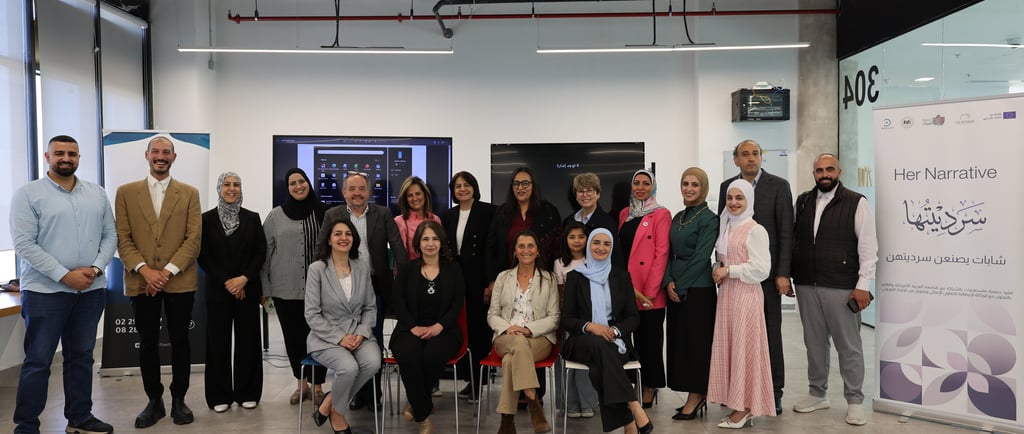
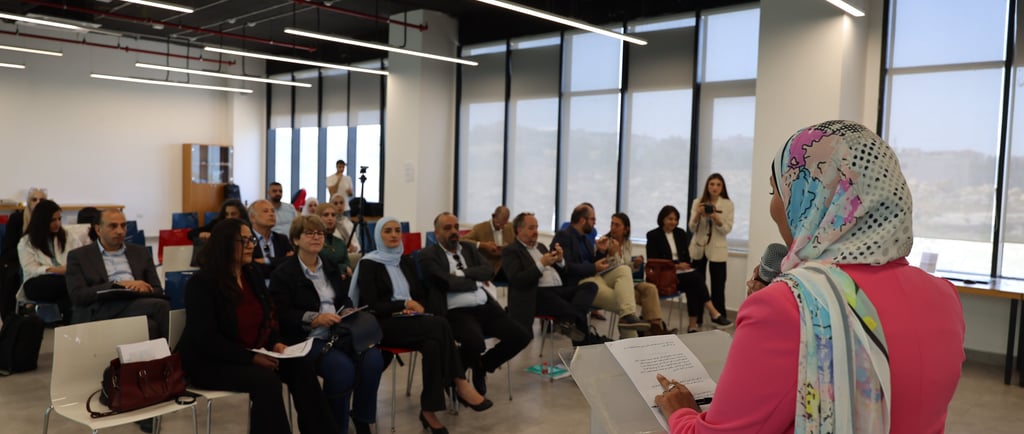
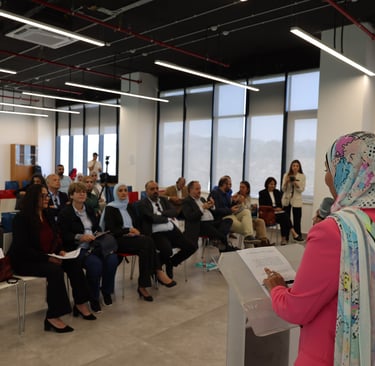
Today, Filastiniyat launched the “Her Narrative” project as an employment initiative targeting female graduates in the cultural and creative industries (CCI), specifically, in media, multimedia, and design — in the West Bank and Gaza Strip. The project implemented by Filastiniyat in partnership with The Arab American University and AL Nasher company, in cooperation with the Italian Agency for Development Cooperation (AICS) and funded by the European Union. The launch event was attended by representatives from universities, production companies, government institutions, and civil society organizations.
“Her Narrative… Young Women Crafting Their Narratives” project, for 21 months, aims to employ the largest possible number of graduates from the cultural and creative industries in the West Bank and Gaza Strip, with the number expected to reach up to 500 female graduates. Participants will undergo specialized training through an academy supervised by Arab American University, and six-month paid internship and practical training placement within private companies and media institutions.
Mrs. Wafaa Abdel Rahman, General Director of Filastiniyat, said that Filastiniyat and its partners will provide a different experience through this project, in which academics, through partners universities, in side the private sector, civil society, and the government, represented by three ministries: Higher Education, Culture, and Women affairs, to light a candle for female graduates in light of widespread unemployment and poor economic and social conditions.
In addition, through this project, they are presenting a different narrative that goes beyond words and is carved into stone. The young women will shape their narrative by carving into stone under the weight of occupation, genocide, and shrinking civic spaces.
Mrs. Abdel Rahman expressed her happiness at the reopening of Filastiniyat’s office in the Gaza Strip, noting that this activity is the first to be held at the Gaza office since October, 2023.
Mr. Serge Maraite, Representative of the European Union in Palestine, expressed his happiness at the launch of the project. He noted that the EU places gender equality and women’s empowerment at the heart of its work. Through its Gender Action Plan, the EU is committed to ending gender-based violence, promoting women’s economic and social rights, and strengthening women’s participation and leadership across all sectors of society.
He added that this means supporting women and girls not only as beneficiaries, but as leaders and agents of change. He also expressed his satisfaction with the strong partnership between civil society organizations, the private sector, and Palestinian universities, as it helps build important links between young female graduates and employers in the media, culture, and creative sectors. He expressed hope that this partnership will help strengthen young women’s skills, improve their access to the labor market, and enhance women’s employment and entrepreneurship opportunities in sectors where women remain underrepresented.
On the other hand, Mirko Tricoli, Director of the Italian Agency for Development Cooperation (AICS), emphasized the commitment of Italian cooperation to the cultural and creative industries sector, as well as to gender equality and women’s empowerment. He affirmed his belief that women’s empowerment is achieved through their active participation in the economic development of society, noting that gender issues are a cross-cutting priority across all programs implemented by Italian cooperation.
Mr. Tricoli thanked Filastiniyat and its partners again, and expressing his hope that these joint efforts will contribute to tangible results and strengthen the meaningful participation of women in the Palestinian economic sector through the cultural and creative industries.
In highlighting the project, Eng. Islam Al-Haddad, the Gaza coordinator of the “Her Narrative” project, from the Gaza office, provided an overview of the initiative, which targets graduates of cultural and creative industries disciplines from the past five years. The project aims to enhance their professional and technical readiness and improve their employment and integration into the labor market through core shared courses, specialized tracks, and practical, gender-sensitive content aligned with market needs, and noted that the unemployment rate among female graduates in these disciplines has reached 51%. However, employed women are more likely to work in their field of specialization, with 43.6% of women working in their creative fields compared to 36.4% of men.
Al-Haddad clarified that the project will serve 500 young women from the West Bank and Gaza Strip, with the participation of 62 institutions and companies, in addition to 32 graduates in Gaza through support for their initiatives. She also explained that Filastiniyat has established a steering committee for the project as an advisory body to support its strategic direction and ensure its alignment with labor market needs, thereby contributing to impact and sustainability.
Mr. Hussein Yassin, Deputy General Manager of Al Nasher Company, presented the platform designed under the name “Karima,” an online training portal, provides an integrated system connecting creative youth, universities, training institutions, private sector companies, knowledge, creative resources, and employment opportunities, as well as employers and experts. The platform will serve as a space for both theoretical and practical training, networking, showcasing creative work, job matching, and a center for knowledge and creativity.
He added that the platform was named (Karima) in honor of the first Palestinian photographer, Karima Abbud, who was born in 1896 and died in 1940 in Nazareth city, so her name will serve as an inspiration to young women. The platform will work to enhance employment opportunities for youth, support freelancing, and showcase talent, alongside academic development that takes into account recent technological advancements and the use of AI tools.
Dr. Hanadi Dweikat, Dean of the Faculty of Media at the Arab American University, also presented an integrated training program for the cultural and creative industries. The program includes core courses across three disciplines—media, multimedia, and design—for the graduates who will participate in the project, in addition to specialized tracks related to each field.
Dr. Dweikat explained that Palestinian universities alone are unable to fully prepare students for the labor market, therefore, this partnership with civil society and private companies helps bridge this gap through a program divided into two parts: theoretical and practical, while also incorporating artificial intelligence tools that will be integrated into parts of the courses.
She concluded that the training contributes to building personal and effective communication skills, and how youth can present themselves and highlight their skills, and they will also work on their own projects and ideas to present to employers, which will allow them to obtain job opportunities in these companies. Finally, the program also focuses on promoting professional sustainability, freelancing, small project management, budgeting, team building, and launching their own initiatives.